
Wedding Run of Show Template, With a Real Example
Couples tend to say timeline and planners tend to say run of show, but the two aren't the same thing. A timeline is for the individual: where do I need to be and when. A run of show, on the other hand, tells you where each moment will happen throughout the day and how to make it unfold seamlessly.
The couple and their guests can get by with a timeline that says the ceremony starts at 3:30 and dinner is at 5:45. You and your vendors need more than that, because someone has to seat the guests before 3:30, cue the musicians, and move the ceremony chairs into the reception. The run of show gives each of those jobs a time, a length, and a person.
This post has a real one to read, a blank one-page template to print, and a walk through how to build your own.
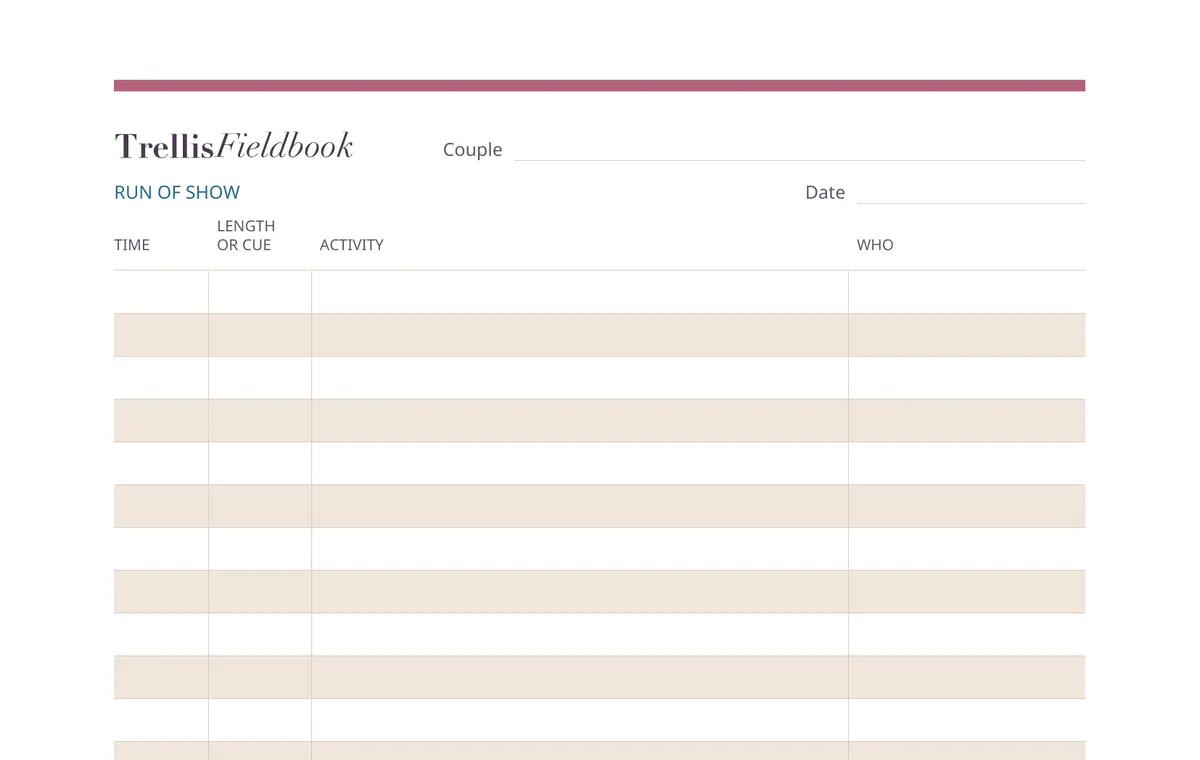
The four columns
Each line in a run of show has four parts.
Time. The time the moment starts. Give each line a single start time rather than a range, since the next column covers how long it runs.
Length or cue. How long the moment lasts. Some moments have no set length and start on a signal instead, so they get the word "cue." The processional is a good example. It starts when the officiant gives the signal, even if that comes a few minutes after 3:30, so marking it as a cue tells the musicians and the wedding party to watch the officiant rather than the clock.
Activity. What happens, written so a vendor knows exactly what to do. "Rentals delivered: chairs, arbor, and lounge furniture" is more useful to the rental company than "rentals" on its own, because it lists what has to arrive.
Who. The person or vendor responsible for making it happen. Use a specific name, like the photographer, the DJ, or the maid of honor. When a line just says "vendors" or "everyone," it's easy for each person to assume someone else has it covered.
Keep other details off the schedule itself. The sample puts vendor contacts in a list at the end, and notes about parking or power outlets belong in a separate document. On the day, people read the run of show in quick glances, so each line should be short enough to take in at once.
How to build one
Start with the two times that won't change: when the ceremony starts and when the venue has to be empty. Then you can fill in the rest of the day between them.
Work backward from the ceremony first. In the sample, the couple does a first look at 12:45, so their portraits, the wedding party photos, and the family formals all happen before guests arrive at 3:00. Fitting all of that in means hair and makeup starts at 7:00. Getting ready often takes longer than planned, so it's worth leaving extra time early in the day, when a delay won't push back the ceremony.
Then work forward to the end of the night: guests seated, the entrance, toasts, dinner, dances, and cake. The last hour is easy to leave out, so add last call, the send-off, the shuttle, vendor load-out, and the time the venue needs to be cleared. Your vendors use those times to plan their own night.
Once you have a draft, read through it once from each vendor's point of view, looking only at the florist's lines, then only at the DJ's, and so on. That's how you find someone booked in two places at once, or arriving after they're needed, while there's still time to fix it.
Mark who each line is for
The sample color-codes each line by who it's for: guests, the couple, the wedding party, family, vendors, or the planner, with a key at the top of the first page. Everyone still gets the full schedule, which helps them see what comes before and after their part, and the colors make it quick for each person to find their own lines. The best man, for example, can spot his speech at 5:30 without reading through the rental company's setup.
Print it with room to write
Something on the day will almost always change, whether the toasts run long or rain moves the portraits inside, so a printed run of show needs space for edits.
The sample leaves a blank row under every line where you can write changes in pen. The blank template uses the same layout. It's one page with the four columns and empty rows, and you can print as many copies as your day needs.
Download the sample and the template
- Sample run of show: Casey and Jordan's wedding, 54 lines over four pages.
- Blank run of show template: one page to print as many times as you need.
If you'd rather type than write, set up the same four columns in a spreadsheet or whatever tool you already use.
The sample comes from Trellis Fieldbook, where the run of show sits in the same wedding record as your vendors and to-dos. You build it on the Day-of screen, color-code it, and print it in the wedding's theme. On the day, you can carry the printout or open the PDF on your phone.